
Autonomous driving is only the first half of providing a driverless transport service.
How many times have you travelled in a lift without realising that you’re taking an autonomous transport service?
Not that long ago lifts had human “drivers”. Lift operators dealt with a range of small tasks to ensure a reliable vertical journey. They responded to calls, controlled speed, stopped level with each landing, managed loading and reassured passengers. We now have full autonomy without much second thought to it, lift operators had their functions reassigned to software and technical solutions. Society accepted a trade-off: lifts became much cheaper and more widely available, but lost the human touch and the extra functions lift operators provided, from helping passengers to explaining the building’s history.
Passenger vehicles face the same challenge on a larger scale. A taxi, bus or shuttle driver does much more than drive. A driver job involves a range of tasks and each will need to be addressed when moving to an autonomous service. Some tasks can be automated quite easily, such as taking payment or identifying a passenger. Others will be much harder but still solvable, such as rerouting the vehicle after the road floods or waking a passenger who falls asleep. Some may not be addressed at all, such as suggesting the best local restaurant or holding the bus for two minutes to let someone run to the door.
Which of these tasks are most challenging? After speaking to the company RideTandem, which partners with minibus and coach operators to help people travel to work, it became clear that many of the most complicated parts of running a high quality service are not related to turning the steering wheel, but managing the hands-on passenger care, physical support, and real-time duty of care that human drivers provide every day. RideTandem has helpfully shared examples of the tasks that transport services will need to solve, redesign, or decide to drop when shifting to an autonomous model.

Lift operators were a common sight in major cities in the early 20th century
To recognise some driver tasks in more detail, let us follow a story of a typical autonomous passenger service journey, narratively aided through a passenger I shall call ‘Jonas’. The story will describe the examples that autonomous vehicle companies address already, the harder tradeoffs are discussed next.
Before the journey begins
Jonas books through an app. The app does several things at once, identifies the passenger, takes payment, records his destination and assigns a vehicle. That works for Jonas, but if an operator chooses to serve everyone they need to provide alternative options to travel without a smartphone.
Before Jonas sees the vehicle, it has already been cleaned, inspected, charged and positioned close enough to collect him. These physical tasks need to be done through human labour between the rides. Autonomous Vehicle companies typically outsource these tasks to third-party fleet management firms, Waymo, for example, plans to work with Moove on fleet operations in London.
This brings an expensive requirement behind the scenes: land. Vehicles need somewhere to park for servicing. Depot space can therefore become one of the largest costs associated with running an autonomous passenger service.
To make sure the vehicle assigned to Jonas is accessible, the booking system needs to provide an appropriate vehicle type. Jonas has no particular accessibility requirements, but someone else may need wheelchair access, or other forms of help such as help locating the car. To address the latter challenge, autonomous vehicle providers such as waymo have developed audio and wayfinding features for blind and visually impaired passengers.
Boarding the vehicle
The vehicle arrives and signals that it is Jonas’s car. He confirms the registration and unlocks it through his phone. A human taxi driver can ask a passenger’s name. Here a system needs to confirm passenger identity to prevent someone else from taking the journey.
Inside, the destination and route remain visible. This replaces a simple but important interaction with a driver: asking whether the service is going to the right place. Having access to the journey information through a screen inside the vehicle is particularly valuable for tourists, children, anxious travellers and some neurodivergent passengers.
Jonas enters the vehicle, takes a read of the destination board inside, presses a button and the journey begins.
During the ride
Jonas follows the rules, but the service must also handle passengers who smoke, damage the interior or threaten others.
Waymo uses interior cameras and rider accounts, allowing incidents to be investigated and sanctions applied after a journey. Shared transport may need faster intervention. A passenger facing immediate danger must be able to contact a remote operator or the emergency services.
Remote support cannot recreate everything a driver can do. A remote operator may see and speak to passengers, but cannot separate people fighting, administer first aid or use a fire extinguisher. A service must decide which incidents can be managed remotely, which require a mobile response team and which risks it is prepared to accept.
Heavy rain has flooded part of Jonas’s route, so the vehicle diverts. If it cannot complete the journey, it must find a safe place for him to leave rather than simply selecting the nearest available point. In such a scenario the vehicle would need to use judgement as to what would be the most appropriate drop off point.
Near the destination, Jonas receives a visual and audio alert. If he were asleep, the system might escalate from recorded prompts to remote contact. If he remained unresponsive, the operator would need to treat the situation as a possible medical emergency.
A different procedure is required for a passenger who is awake but refuses to leave. Without one, a single person could indefinitely remove a vehicle from service.
Operators must also plan for deliberate misuse. Autonomous vehicles may be used during criminal activity, creating questions about what information is retained and when it can be shared with law enforcement.
Jonas, however, is simply travelling to work.
After the ride
The vehicle stops beside the pavement. Jonas takes his bag, steps out and closes the door.
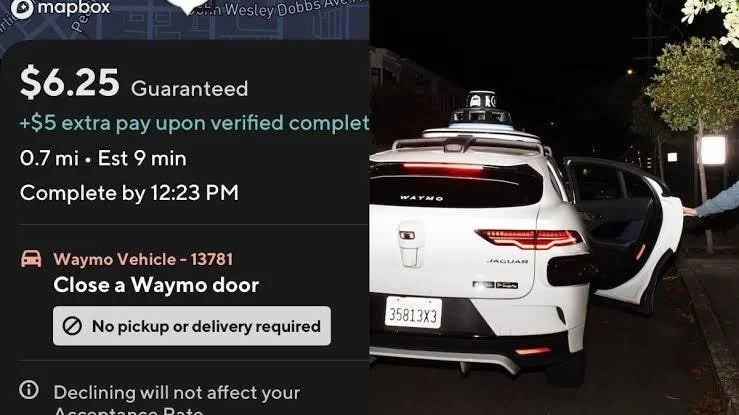
Something as simple as making sure the door is closed can become an operational challenge. A driverless vehicle may be unable to continue if a passenger leaves a door open. Waymo has used roadside-assistance and gig-economy workers to close stranded vehicle doors, accepting a small human intervention instead of immediately redesigning their cars.
Had Jonas left his bag behind, the operator would need to locate, secure, store and return it. Jackson Lester’s account of losing his wallet in a Waymo shows the infrastructure involved: customer support redirected the vehicle to a depot, staff searched it and the recovered wallet was placed in a collection locker.
Some objects require different treatment. RideTandem once dealt with raw chicken left in a vehicle. That’s an obvious hygiene risk and a driver would chuck it out without question. But in a driverless service, rules need to be established to distinguish valuables from food, rubbish, or dangerous materials and illegal items. Jonas leaves nothing behind to avoid mistakes. The vehicle is ready for its next passenger.
New trade-offs
Autonomous vehicle operators have found creative ways to make Jonas’ journey smooth going. They implement new technical solutions and take tradeoffs to complete the small tasks that are typically completed by a human driver. Taking these tradeoffs distributes the responsibility for a successful journey across actors. It is split between software, remote support and depot workers. This can make transport cheaper and more widely available when executed well.
But there are new tradeoffs involved. What if Jonas had a heavy suitcase to take into the vehicle? There would be no driver to help him. These tradeoffs matter a lot to certain passengers, particularly those with additional accessibility needs. Automation also faces the challenge of addressing socially mediated actions such as checking on a distressed passenger, or enforcing a no smoking rule. Some of these tasks can be addressed through human fall-backs, such as the ability for a remote operator to call-in and talk to passengers, whilst others such as the luggage tasks, autonomy operators may choose not to address at all.
Losing some features for much cheaper access is a tradeoff society took before with lifts.
But this is also where the lift analogy starts to break down. Lifts have few alternatives: you either take the lift or you do not. Road transport has much more variation. Additionally, policy can guarantee alternatives, for example by requiring some buses to have wheelchair ramps, placing attendants on bus routes used by many elderly passengers, or ensuring that a proportion of robotaxis have additional accessibility features.
Nevertheless, policy does not need to anticipate every trade-off immediately. Human driven services will still be around. Autonomous transport will take years to implement so passengers who prefer the human touch will be able to get it.
Overall the goal for autonomous transport services is to provide cheaper, and safer transport. So just as autonomous transport operators will need to be thoughtful about the tradeoffs required to achieve efficiency, reliability and accessibility they will also need to be thoughtful on safety. The optimal solution for lifts was to have nearly all ‘trips’ be automated with a human fallback thanks to the button in the lift to call the technician. Road transport may end up in a similar situation in the long term future, a reliable system that handles almost all cases with human fallbacks which would allow for better transport at a much lower cost.
