
How do you get permission to run a Robotaxi service in London?
Wayve have made the jump from testing on London’s streets to picking up paying passengers. Book an Uber and you can now be matched with a Ford Mustang Mach-E that uses Wayve’s automated driving technology, with a human safety driver still behind the wheel.
How did they get permission? Through the private-hire licensing framework used for an ordinary London Uber journey. To get to this stage Wayve and Uber had to get three licences involved, each granted by TfL:
The operator licence - For the business accepting bookings and arranging journeys. Uber already had this.
The driver licence - The people supervising these cars need one to work as a private-hire drive, alongside their ordinary driving licence.
The vehicle licence - Covers the individual car carrying passengers. TfL granted these to the Wayve-equipped vehicles, completing the set for the service.
But for Wayve to start a fully driverless service, it will need to take a different route. For this the government developed a dedicated Automated Passenger Service permit, (APS permit). Waymo is also pursuing this route.
But first, let’s go back a step. How does a company get from its first cars on London’s roads to a driverless service anyone can book?
Trailing an Autonomous Vehicle Service.
First, an autonomous vehicle company and it’s software needs to get to know the city: its junctions, roadworks and the negotiation culture that happen when two vehicles meet on a narrow street.
Waymo has been doing this with around 100 cars in London. Wayve has been testing for years, and this summer Baidu’s Apollo Go joined them. There have even been sightings of Nvidia-branded cars.
Supervised trials don’t require a unique trial permit. But the government does have a preference for how these trails are conducted. This is where the automated-vehicle trialling code comes in. Published by the Department for Transport, the Code explains how companies should conduct trials safely. It is non-statutory: meaning that it’s a form of guidance rather than an official licence or a separate set of criminal offences.
The code expects companies to prepare a safety case. That is, an evidence-backed explanation of why the trial is safe. This safety case needs details on how the firms train their drivers, manage risks and record vehicle data. The safety driver must remain ready to intervene, even if the software never asks for help.
Sometimes, there’s another hurdle to clear at this stage. If the company is using cars that are heavily modified or purpose built they may need to apply for a Vehicle Special Order, or VSO, to operate on the roads legally. These are issued by the Vehicle Certification Agency, or VCA, part of the Department for Transport. We’ll return to VCA when it is time to remove the safety driver.
Once the company has gathered experience on the roads, the next question is how to turn that testing into a passenger service.
The Automated Passenger Scheme application process.
The main regulatory player here is the Driver and Vehicle Standards Agency, or DVSA, also part of the Department for Transport. The DVSA reviews proposals for any automated passenger transport service, and issues APS permits on behalf of the Transport Secretary.
Firms that apply for an APS permit application need to answer two questions: can the vehicle safely drive autonomously, and can the business safely provide and operate a public passenger service?
The VCA assesses the first. During the current pilot period, the vehicle must be listed as self-driving under the Automated and Electric Vehicles Act 2018. The Transport Secretary makes that decision to include the vehicle in the official list of self-driving vehicles, as evidenced by the VCA’s assessment. The vehicle cannot depend on a human watching for mistakes and intervening immediately.
Removing the driver also brings us back to the VSO. Even a car with a conventional steering wheel may need an exemption: the pilot guidance identifies the existing rule about leaving vehicles unattended as an expected issue. Applicable vehicle approval, registration and insurance requirements must also be addressed.
Then there is the insurance which is handled by the 2018 Act. Initial civil liability for qualifying accidents caused by a listed vehicle while driving itself falls on the insurer, which may then recover costs from another liable party.
The next question is the company informing the VCA on the geographical boundaries of where the vehicle can drive autonomously. The technical term is its operational design domain: the roads and conditions in which the system is designed to operate. Proving that it can handle particular London streets does not establish that it can drive anywhere, in any weather.
The passenger service allowed in the permit may be narrower still. A car could be capable of operating across a broad area, while its APS permit allows journeys only in parts of Camden and Westminster, during specified hours.
Within that area, DVSA examines how the service will work for the people using it. If a car stops somewhere awkward, who responds? If a passenger cannot open the door, how do they get help? How will disabled passengers use the service, and how will vulnerable passengers be protected?
To assess those arrangements, DVSA reviews documents, visits the operation and inspects vehicles before deployment. Its work can run alongside VCA’s assessment, so the processes can occur in parallel.
Those national assessments still leave a local question: how will the service fit into London?
TFL’s role
For a London taxi-like or private-hire-like APS, TfL must consent. Boroughs do not have any formal role here, although they may be involved in any relevant wider-consultation during the process.
The formal consent process gives TfL six weeks to decide once DVSA makes its written request. If TFL refuses, they need to write down their reasons. If TfL does not address the permit request within 6 weeks or refuses without providing written reasons, consent is treated as given.
And what if TfL says no? A valid refusal ends that application: DVSA cannot issue the permit. There is no specific statutory appeal against the local consent decision, although a company may seek to challenge it, including through TfL’s own procedures.
In practice, a company could revise its plans and try again, such as with a modified permit application, with fewer cars or a smaller area. But TfL is not obliged to say yes eventually.
That is why the government recommends negotiating changes before the formal request. Unresolved objections could create a prolonged stalemate.
For me, this is what makes TfL’s role interesting: it has a chance to address the practical questions that will shape Londoners’ experience. Where will empty cars wait between bookings? Will pick-ups block buses or pavements? Will the service make travel easier for people who currently struggle to get around?
Those questions fit TfL’s stated priorities for automated vehicles: safety, efficient roads, accessibility, environmental outcomes and security. A car’s ability to navigate London is only part of whether its service will work well for London.
A yes from TfL allows the application to proceed, but DVSA must still complete its assessment before granting a permit. The final stages include consulting traffic authorities and emergency services. Once that’s checked off the permit can be granted.
These discussions may be renewed if the autonomous vehicle company ‘the operator’ requests any substantive change which would require TFL’s consent to be renewed. DVSA also monitors the service and can suspend or withdraw the permit.
As it stands, any APS permit is temporary. The government has set a five-year maximum, with initial pilot permits expected to last around 12–18 months. But once the Automated Vehicles Act Secondary legislation is wrapped up in late 2027,. The APS framework will be shaped in away to allow for more permanent licensing.
Wayve has started the first supervised autonomous vehicle service in London. The next announcement to watch for is permission to remove the safety driver. That will mean the vehicle has demonstrated it can drive itself and the passenger service has been approved to operate within agreed limits.
The chart below provides a quick overview of this process.
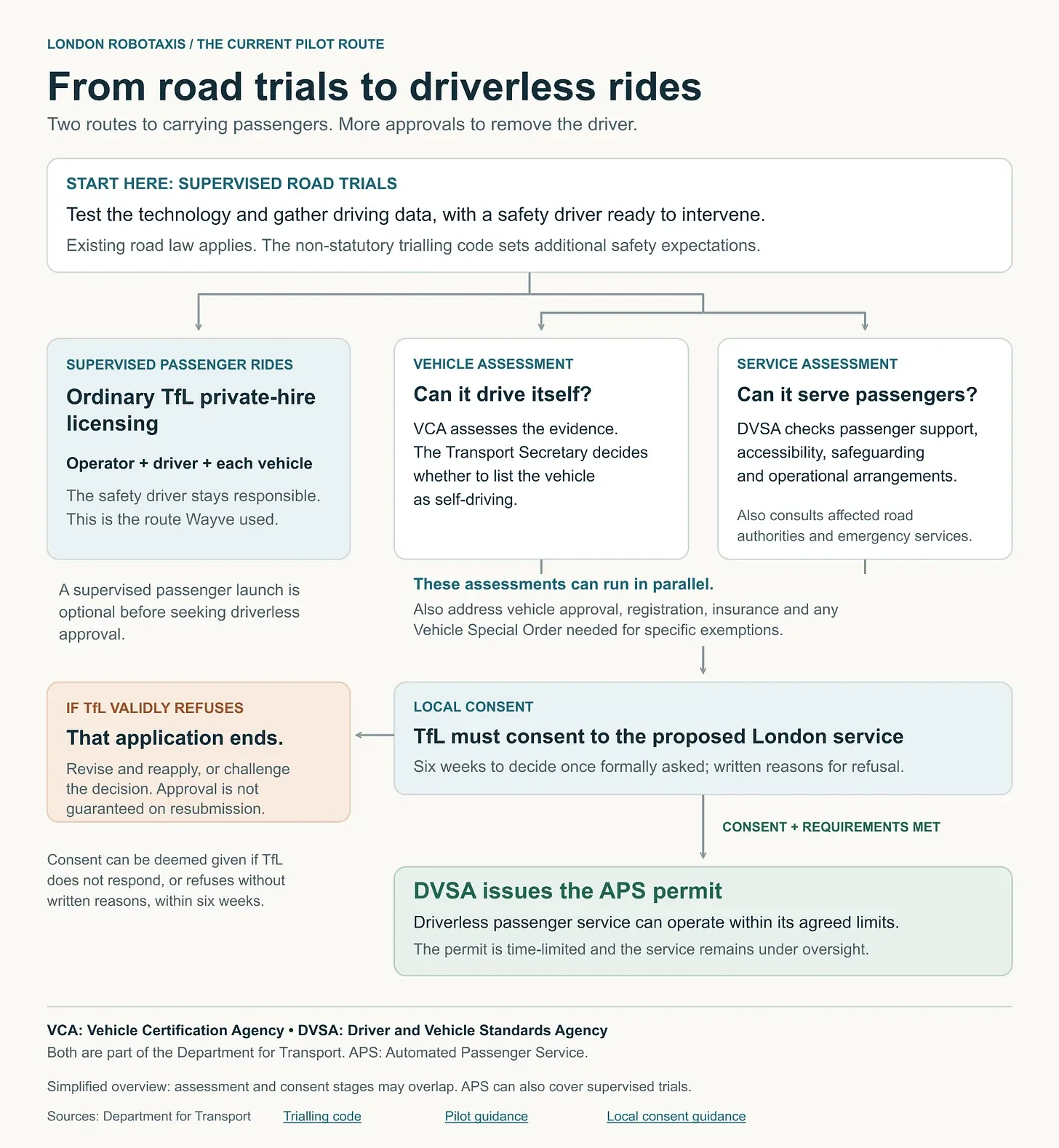
As the companies apply for the APS permits and the regulatory environment solidifies there will be plenty more regulatory conversations to follow in the road to widely available autonomous transport options.
6 Likes
